Prompt 3:
I do not believe that fate has played a role in my life. I don't believe that fate is a factor in life, except for the end result of life. In that regard, everyone has the same fate. It is said that death is the great equalizer, because everyone has the same status when they are deceased. However, Shakespeare would likely disagree with me about the role of fate in a person's life.
He likely believed that fate was an important factor in life, as shown through the witches' prophecies in Macbeth. He portrayed these prophecies as inescapable, and something that would happen no matter the actions of the characters. This is shown through the prophecy delivered to Banquo, where he is told that his son will be a king. Banquo does nothing to further the goal of this prophecy, and yet it still comes true. This is an example of Shakespeare's fatalistic worldview, where fate governs the lives of all people.
Another example of this is the central prophecy of the play, the one delivered to Macbeth. It is said that he will become the thane of Cawdor, and then the king of Scotland. The entire play revolves around the consequences of Macbeth's fulfillment of the prophecy, where he becomes incredibly paranoid and untrusting of his closest friends. Macbeth kills the current king in order to become the king of Scotland, driving the inheritor of the throne away from the country. This allows him to take control, and his worry about the prophecy delivered to Banquo drives him to kill. It is unclear whether Macbeth would have become king if he had not killed Duncan, but I think that Shakespeare believed that it would happen. The reason he kills Duncan is due to the incessant thirst for power present in his wife, who drives him to commit regicide.
Sunday, November 23, 2014

Sunday, October 19, 2014
Wrath and ISIS recruitment: Blog post 4
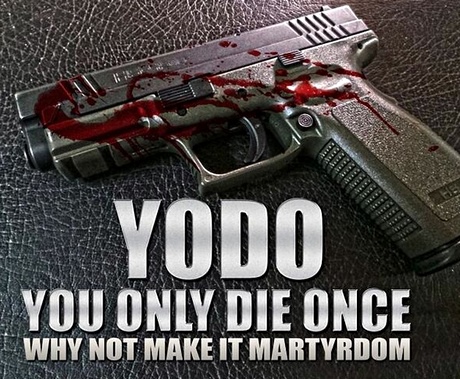
Author: ISIS
Date of Publication: Unknown, republished June 23, 2014
Published on: ISIS social media, republished on The Guardian
Denotative Examination:
This advertisement/recruitment photo is fairly straightforward in its appearance. The centerpiece of the photo is a single handgun sitting on what appears to be a leather surface. The handgun appears to be a variation of the Glock company weaponry, and has blood on it. The text is prominent and contains an acronym of the phrase "you only die once." The text is entirely capitalized and also asks a question about why the viewer is not going to become a martyr. The image was created by the Islamic State of Iraq and Syria (ISIS), a jihadist group fighting for control of Iraq and Syria.
Connotative Examination:
Upon closer examination, this ad has much more to reveal The acronym "YODO" is a play on the expression "YOLO" which is short for "you only live once." This was a popular expression in American pop culture, and was popularized by the hip-hop industry. The use of blood to cover the handgun implies that the previous user died, and may be implying that they became a martyr. The casualness of the final piece of text is surprising, as it is dealing with a heavy topic for many people. The ad asks "Why not make it martyrdom" as though that is something without any sort of significance, when in reality it is asking someone to lay down their life for their religion. This is showing the deadly sin of wrath, as fighting for ISIS is usually fueled by anger and resentment towards "the West." The ad also shows a weapon covered in blood, symbolizing the anger of someone who joins the jihadist group.
Intended Audience:
The intended audience for this is young, English-speaking, Muslims. This is evidenced by both the content and placement of the image. It was distributed through an ISIS owned social media account, which caters towards young people. ISIS's strategy is to entice young Muslim people who are searching for a purpose, and give them a reason to fight. The content in the image is in English, making it appeal to English speakers who are also Muslim and may be looking to join ISIS.
Sunday, October 5, 2014
Jane Eyre is a alien? Question 6 response
In the excerpt I read of the novel Jane Eyre, the character Jane is alienated from the rest of the girls in her school. This is done to prevent the from catching her immorality, as she is viewed as being wildly immoral. The headmaster of the school claims that she is a liar, and this is seen as a horrible and wicked thing. The society around her refuses to believe that she is not a liar, as she has already been called such, and any attempts to disprove it would be seen as more lies. This alienation by the headmaster is shown to be religious in nature, as the school is meant to educate girls in becoming upstanding members of society. It is fully accepted that the headmaster's word is the law, even though this has been shown to be false earlier in the passage. He was shown to be a liar and a hypocrite when his family entered the inspection, decked out in fancy clothes and hair styles that he had earlier called immoral.
The contrast between the reception of Jane Eyre and the infallibility of Mr. Brocklehurst shows obvious truths about the Victorian society Jane Eyre was written in. It shows that, like in most societies, adults are seen as more reliable than children or teens, and often viewed as infallible. The society demonstrated in the excerpt places a large importance on male authority figures, and they are seen as being in control and more important. They cannot do anything wrong in the eyes of the people in the reform school, and even if they did nobody would complain out of fear.
The contrast between the reception of Jane Eyre and the infallibility of Mr. Brocklehurst shows obvious truths about the Victorian society Jane Eyre was written in. It shows that, like in most societies, adults are seen as more reliable than children or teens, and often viewed as infallible. The society demonstrated in the excerpt places a large importance on male authority figures, and they are seen as being in control and more important. They cannot do anything wrong in the eyes of the people in the reform school, and even if they did nobody would complain out of fear.
Sunday, September 21, 2014
Names: Whats in them?
Names are pretty important, because without them how would we recognize things? Names help us to figure out important information about a person. A name can tell society the gender, ancestry, and primary language of a person. Sometime it can even reveal the age of someone. This emphasis on the importance of a name has permeated American society. Studies conducted by Steven Levitt, an economics professor at the University of Chicago, have shown that resumes with stereotypical African-American names received less responses than identical resumes with stereotypical Caucasian names. This shows that the bias associated with names can result in discrimination.
My family name is one of the most important things I possess. It is unique, and nobody can take it away from me. I am proud to bear my family name, and while I cannot trace it back very far, I am glad that I have a distinct last name. I've always seen it as my responsibility to carry on, because I'm one of under 10 people in the United States with my family name. A name is something to be proud of, no matter the decisions of your ancestors. I want to make my name known in the world.
The problem of being an individual inside of a larger group is challenging. It applies to everyone, as they cannot help but be part of some larger group. I am an individual, but there are many other groups that I affiliate with. I see myself as belonging to my family, the Millbrook student body, a proud resident of North Carolina, as an American citizen, and as a member of a global community. These can cause conflicts sometimes, as there are many other groups that sometimes conflict. My identity as a Southerner sometimes conflicts with my views as an American citizen. The multiple ethnic identities I belong to often hate each other or are very complicated. My great-great-grandmother was an ethnic German living in Alsace-Lorraine, but was considered French by many people. Even today, people refuse to believe that a person from Alsace-Lorraine could be German. Overall, I belong to many groups, but identify more strongly with some than others.
My family name is one of the most important things I possess. It is unique, and nobody can take it away from me. I am proud to bear my family name, and while I cannot trace it back very far, I am glad that I have a distinct last name. I've always seen it as my responsibility to carry on, because I'm one of under 10 people in the United States with my family name. A name is something to be proud of, no matter the decisions of your ancestors. I want to make my name known in the world.
The problem of being an individual inside of a larger group is challenging. It applies to everyone, as they cannot help but be part of some larger group. I am an individual, but there are many other groups that I affiliate with. I see myself as belonging to my family, the Millbrook student body, a proud resident of North Carolina, as an American citizen, and as a member of a global community. These can cause conflicts sometimes, as there are many other groups that sometimes conflict. My identity as a Southerner sometimes conflicts with my views as an American citizen. The multiple ethnic identities I belong to often hate each other or are very complicated. My great-great-grandmother was an ethnic German living in Alsace-Lorraine, but was considered French by many people. Even today, people refuse to believe that a person from Alsace-Lorraine could be German. Overall, I belong to many groups, but identify more strongly with some than others.
Monday, September 8, 2014
Subscribe to:
Posts (Atom)